
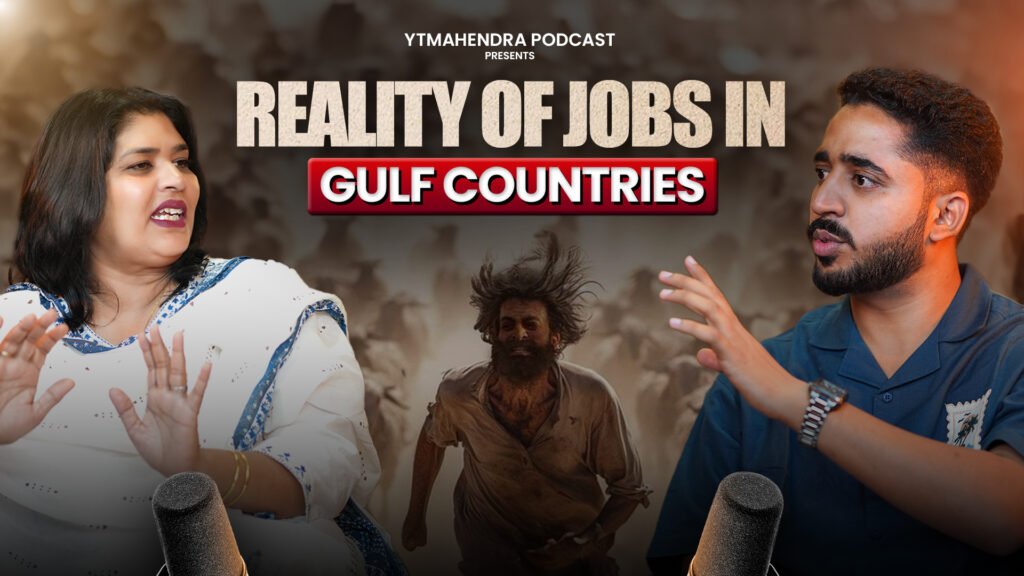
When people in India dream of working in Gulf countries, they imagine high salaries, a luxurious lifestyle, and a better future. But behind this glitter exists a darker reality, one that very few talk about openly.
In our recent podcast episode, Human Rights Activist Shaheen Sayyed joined us to shed light on the real job conditions in Gulf nations like the UAE, Kuwait, Saudi Arabia, Bahrain, and Qatar. Through first-hand stories of migrants she rescued, she revealed the shocking truth many agencies and employers hide.
Here are the real, heartbreaking cases she narrated, each a mirror reflecting the harsh truth behind the glamorous promise of Gulf jobs.
Story 1: The Merchant Navy Worker Abandoned in Nigeria for 2 Years
“He lived alone on a dead ship. No food. No money. No one to help.”
Our first story revolves around Shankar Rao, a seafarer from Visakhapatnam who worked on a merchant navy ship. The company allegedly made an illegal entry into a Nigerian port, and authorities arrested three crew members.
While the company bailed out two Nigerian workers, Shankar was left abandoned, completely alone on a non-functioning ship for nearly two years.
He survived by:
- Swimming to shore to charge his phone
- Eating minimal food
- Calling the Indian Embassy multiple times (who eventually blocked him)
When Shaheen discovered his case, she:
- Connected him with local NGOs in Nigeria
- Arranged food, clothes, and money
- Forced the Embassy to take action
- Got his outpass issued
- Arranged travel back to India
- Even paid for the last leg of his journey
He was finally reunited with his family after years of traumatic isolation.
This case highlights:
- Embassy negligence
- Lack of structured rescue systems
- Communication barriers
- Zero accountability of foreign shipping companies
This is one of the most shocking real job realities of Indians working in foreign waters.
Story 2: The Beautician Sold to a Bangladeshi Couple – A Heartbreaking Trafficking Case
“She was promised America. She landed in Kuwait. And then she was sold.”
A young Indian beautician was promised a job in America, but her recruiter trafficked her to Kuwait and sold her to a Bangladeshi couple who ran a salon.
Her nightmare began when:
- She refused to do illegal, inappropriate services for male clients
- The husband tried to rape her, while the wife supported him
- They beat her, injured her, and threatened her
- They even vandalized their own shop to frame her
- They called the police to accuse her of damaging property
Shaheen stayed on phone with her throughout the attack and instructed her how to hide safely until help arrived.
Through:
- Emotional support
- Legal intervention
- Pressure on the sponsor
- Embassy push
- Ticket arrangement
…Shaheen successfully brought her back to India.
This story shows the harsh job realities for women in Gulf countries, especially under the Kafala system, where domestic workers can be:
- Bought
- Sold
- Controlled
- Exploited
Story 3: Six Months Abroad Feels Like a Lifetime – Mental Health Crisis Among Workers
Shaheen explains that people often say: “Six months kaam kar ke aa jaaunga.”
But the reality is completely different. Workers suffer from:
- Intense homesickness
- Culture shock
- Depression
- Exploitation by employers
- Salary cuts
- Overwork without breaks
Many don’t earn what they were promised. Many want to return home immediately.
Yet social media pressures force them to pretend they’re living the “Dubai Dream.”
Story 4: The Dangerous Myth of the “Azad Visa”
“Azad visa does not exist. It is completely illegal.”
In India especially Rajasthan people often talk about “Azad Visa.”
Shaheen explains:
- No Gulf country provides such a visa legally.
- It is simply a visa bought from a sponsor.
- The worker pays money to be “free,” but everything remains illegal.
The risks include:
- Immediate deportation
- Permanent ban from the country
- Jail time
- No legal protection
This is one of the biggest Gulf job scams affecting Indian workers.
Story 5: Domestic Workers – The Most Exploited Category
According to Shaheen, domestic workers are the most vulnerable and exploited group among migrants going to Gulf countries. She firmly believes that India should reconsider sending housemaids abroad because the risks they face are far greater than the benefits promised by agencies. Many women suffer severe physical abuse, sexual harassment, and extreme overworking conditions without any weekly holidays or proper rest. Their passports are often confiscated the moment they arrive, leaving them completely dependent on employers and unable to escape abusive environments. The isolation of living inside someone’s home, away from the public eye, further exposes them to silent suffering.
When these women try to run away from abusive employers, many unfortunately fall into even worse situations. Some get trapped in prostitution rackets, while others become part of illegal labour networks where exploitation continues on a larger scale. Shaheen emphasizes that women seeking jobs abroad should instead be guided toward safer alternatives such as mall cleaning, garden maintenance, or company cleaning staff positions. These jobs offer legal contracts, fixed working hours, and most importantly, no live-in vulnerability. Unlike domestic work, these sectors provide a structured environment where exploitation is significantly lower and workers have better access to help, rights, and legal protection.
Story 6: The Kafala System – Modern Slavery in a Legal Form
Shaheen described the harsh truth behind the Kafala sponsorship system, calling it a form of “legalized modern slavery” that still operates in many Gulf countries. Under this system, employers, also known as sponsors, essentially buy workers by paying agencies an amount ranging from 900 to 1400 dinars. Maids are shockingly “selected through photos,” treated like objects rather than human beings. Once a sponsor pays this amount, they start feeling a sense of ownership over the worker. This is when the real suffering begins.
The worker’s passport is immediately confiscated, cutting off her ability to move freely or return home. She cannot leave the job, switch employers, or even step outside without the sponsor’s permission. This absolute dependency creates the perfect environment for abuse and Shaheen says almost every case of exploitation she handles has roots in this system. The Kafala model strips workers of their basic rights and traps them in a cycle of fear, control, and helplessness.
🔥 Story 7: Embassy Negligence – A Huge Part of the Problem
Shaheen strongly highlighted how embassy negligence often makes an already difficult situation much worse. Many workers try contacting Indian embassies in moments of extreme crisis, but their calls frequently go unanswered. Emergency helpline numbers don’t respond, and distressed migrants, especially housemaids, have no idea where to turn when their employers become abusive. Even lawyers who fight migrant cases mention that they do not receive the necessary cooperation from embassy officials.
As a result, workers remain stuck for months or even years with no support system. To fix this, Shaheen suggests several much-needed reforms: mandatory awareness sessions at departure points, emergency helpline cards distributed at Indian airports, visa verification desks to detect fake agents, and reduced fees for outpasses so stranded workers can return home without financial burden. She insists that without embassy involvement, migrant protection cannot improve.
Story 8: Death of Indian Workers Abroad – The Harsh Reality
People rarely talk about what happens when:
- An Indian worker dies while working abroad
- A runaway migrant dies
- A tourist without insurance dies
She explains:
- Legal workers’ repatriation is handled by companies
- Illegal workers’ bodies are often stuck for months
- Embassies sometimes depend on community fundraising
- Travel insurance is absolutely essential
This is an important but ignored part of Gulf migration challenges.
Final Thoughts: The Real Job Realities in Gulf Countries
The stories shared by Shaheen Sayyed prove one thing:
Gulf countries offer opportunities, but they also come with extremely high risks if workers are uneducated, misled, or illegally recruited.
The biggest issues include:
- Fake job offers
- Illegal Azad visas
- Kafala exploitation
- Agent fraud
- Domestic worker abuse
- Lack of awareness
- Mental health breakdown
- Embassy inaction
Through her work, Shaheen continues to rescue countless Indians suffering abroad. Her message is clear:
“Never go to Gulf without full legal awareness. A single mistake can destroy your life.”
If You’re Planning to Work in Gulf Countries, Remember This
✔ Always verify visa with embassy
✔ Use only licensed recruitment agencies
✔ Avoid Azad visa scams
✔ Know emergency laws
✔ Avoid domestic worker job roles
✔ Save embassy numbers
✔ Keep family updated
✔ Keep copies of all documents
✔ Get travel insurance
Conclusion: Changing the Narrative Around Gulf Migration Starts With Awareness
The stories shared by Human Rights Activist Shaheen Sayyed reveal a truth most people never see behind the glamorous idea of “Gulf jobs.” While thousands dream of a better life abroad, countless others silently suffer abuse, unpaid labour, passport confiscation, exploitation, and even death. These cases are not isolated incidents, they are symptoms of a deeper systemic failure involving fake agents, the Kafala system, negligent employers, and inadequate embassy support.
Yet, Shaheen’s work also proves that change is possible. When workers are aware of their rights, when families verify visas before sending anyone abroad, when embassies become accountable, and when governments take stronger action against illegal recruitment, migrant exploitation can be drastically reduced.
As Indians, we must stop chasing illusions and start understanding the real job realities in Gulf countries. Gulf nations are not the problem; lack of awareness is. Safe migration is possible, but only when workers are empowered with the right information.
This blog is not just a collection of stories, it is a wake-up call.
If you or someone you know plans to work abroad, make sure the decision is informed, legal, and safe. Your life is worth far more than a promised salary.
Follow Shaheen Sayyed – https://www.instagram.com/shaheensayyed_/