
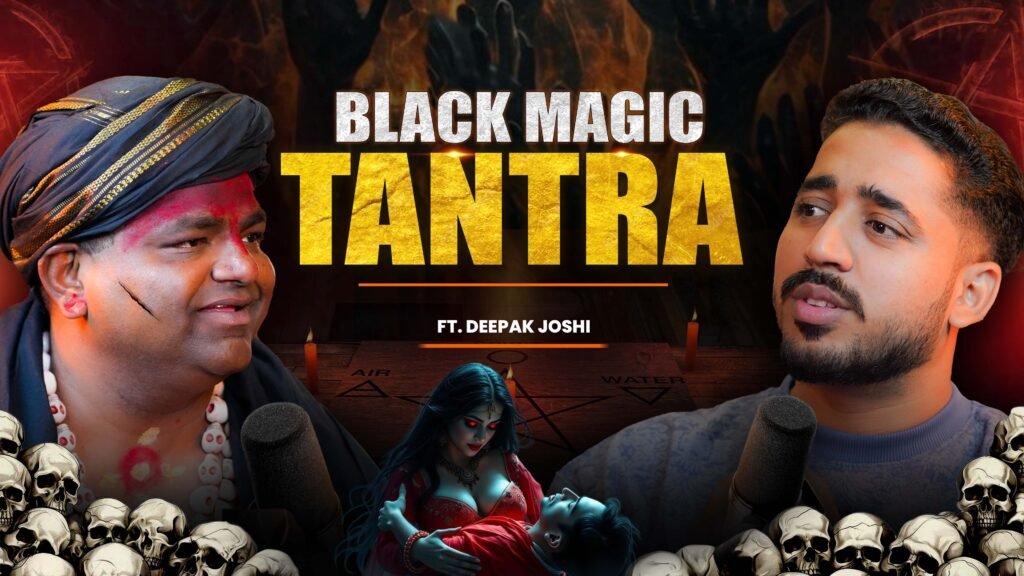
In our latest episode, we welcomed Deepak Joshi Ji, a spiritual practitioner who has spent most of his life involved in traditional tantra, mantra, and ritualistic practices. As he joined us for the first time, the conversation offered an interesting blend of personal history, cultural beliefs, and his perspective on how tantra is portrayed in today’s social media driven world.
Tantra in the Age of Social Media
We began with a question that many viewers often ask:
With so many people on social media claiming to perform “tantra,” showing rituals, energy demonstrations, or exaggerated displays, how much of it is actually real?
Deepak Ji responded firmly. According to him, every spiritual practice has its own discipline, environment, and sanctity, and it cannot be performed just anywhere for public entertainment. He compared it to medical treatment: “A patient is treated in a hospital, not on the road. Similarly, certain rituals have their own place and environment.”
He believes that today, many people misuse the word tantra for views, drama, or popularity, which distorts the essence of a centuries-old tradition.
A Childhood Shaped by Spirituality
When Deepak Ji began speaking about his early life, there was a quiet sincerity in his voice. He shared that his connection with spirituality didn’t begin in adulthood or even in his teenage years , it began long before he truly understood what it meant.
As a seven-year-old, he would quietly sit near his father during rituals, watching every movement with wide eyes. What began as simple curiosity soon became a routine part of his childhood. While other children woke up thinking about school or playtime, he often found himself watching lamps being lit, mantras being chanted, and preparations for rituals unfolding right before him.
His father, who was also connected to traditional practices, never forced him into the path. Instead, the environment itself shaped him. The sounds, the smells, the atmosphere, all of it created a natural pull. Growing up in such close proximity to rituals allowed him to absorb things effortlessly, the way a child learns a language simply by hearing it every day.
By the time he turned fifteen, he wasn’t just observing anymore. He had grown confident enough to perform certain rituals on his own. It wasn’t a dramatic shift, it happened quietly, almost organically, as if he had simply stepped into something that was waiting for him all along.
For Deepak Ji, this journey was never about following a family profession or choosing a career path. He doesn’t see it as a business, nor does he talk about it like a skill he “decided” to learn. Instead, he describes it as a gift, something that came to him naturally, the way some people discover music or art without ever remembering when they started.
“It was always there,” he said, “like a voice guiding me.”.
Role of the Guru and Discipline in Ritual Practices
One point he emphasized repeatedly was the importance of a guru. According to him, no ritual, mantra, or spiritual process can be learned or perfected without a teacher’s guidance.
He clarified that these practices are not commodities that can be bought or sold. Some people, he said, contact him requesting certain rituals in exchange for money, but he believes this is not how the tradition works. Rituals, in his view, require commitment, discipline, and often years of preparation.
Traditional Attire and Symbolism
Throughout the conversation, viewers noticed his distinct attire, specific clothing, rudraksha beads, and symbolic accessories.
When asked about it, he explained that this is not a costume but a part of his spiritual identity. For him, the attire serves multiple purposes:
- It prepares the mind for ritual work
- It is required during certain practices
- It acts as a personal reminder of discipline and commitment
He believes that everything a practitioner carries, beads, sacred items, or symbolic tools, has significance within their tradition.
Experiences and Energy
Deepak Ji also shared that during certain rituals or at specific locations, he feels a heightened sense of energy. Whether one interprets this spiritually, psychologically, or symbolically, it is an essential part of his personal experience and belief system.
Conclusion
Our conversation with Deepak Ji provided a glimpse into a world that many people talk about but few truly understand. Whether or not one agrees with every belief, his journey reflects a lifelong dedication rooted in tradition, discipline, and personal faith.
In upcoming episodes, we’ll continue exploring more such perspectives, where culture, spirituality, and personal experience intersect. If you’re curious about the deeper layers behind such traditions, this conversation is a meaningful starting point.
📲 Follow Our Guest: :-
Jay Mataji Joshi (Deepak Ji) Instagram :- / jay.matajijyotish
Contact no :- +91-6376242797